

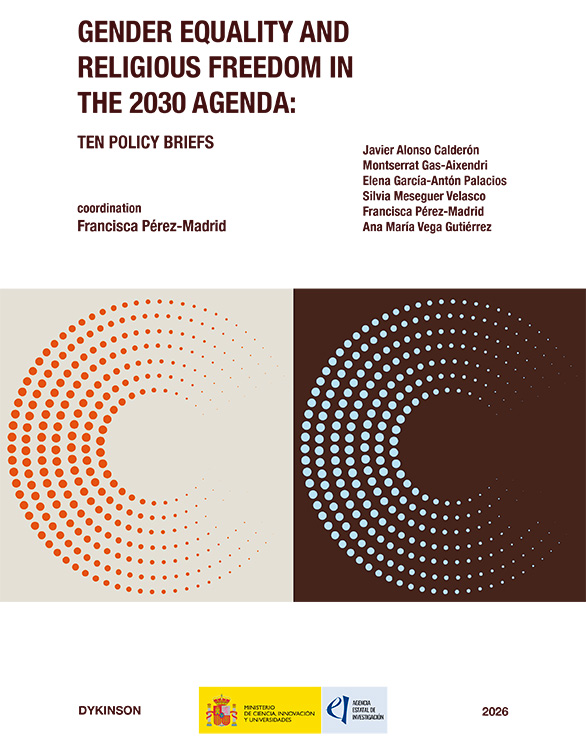
Gender equality and religious freedom in the 2030 agenda: ten policy briefs
The policy briefs gathered in this volume share a clear premise: gender equality and freedom of religion or belief are fundamental rights of equal standing, whose coexistence cannot be resolved through abstract hierarchies. As emphasised in the Vienna Declaration and Programme of Action (1993), human rights are universal, indivisible and interdependent, and must be interpreted jointly, with due regard to their mutual interrelation and the concrete circumstances in which they are exercised. This perspective aligns with the 2030 Agenda for Sustainable Development: SDG 5 (Gender Equality), SDG 10 (Reduced Inequalities) and SDG 16 (Peace, Justice and Strong Institutions) all call for integrated approaches to fundamental rights, recognising that neither equality nor freedom can be fully achieved in isolation from the other.
The contributions span a wide range of fields — from education, healthcare and sports governance to family law, asylum and the public sphere — and share a common methodological approach: each brief identifies the policy problem, analyses the applicable legal framework at international, European and national levels, sets out concrete policy options, and formulates prioritised recommendations addressed to legislators, public administrations and international bodies.
A central argument running throughout the volume is that many contemporary tensions between gender equality and religious freedom stem not from an inherent incompatibility between rights, but from the way public policies are designed and implemented. Clear standards of balancing, coherent legal frameworks and appropriate organisational solutions can foster more stable and inclusive forms of coexistence. The relationship between these two fundamental rights cannot be understood as a zero-sum dynamic. The challenge lies in managing the tensions inherent in pluralism in a fair and balanced way — so that no individual, and especially no woman, is compelled to renounce her rights, her beliefs or her identity in order to participate fully in public life.
This volume is the result of research project PID2020-114400GB-I00, funded by MICIU/AEI/10.13039/501100011033.
Cita 'Chicago'
Pérez Madrid, Francisca, coord. Gender equality and religious freedom in the 2030 agenda: ten policy briefs. Madrid: Dykinson, 2026.
Cita 'APA'
Pérez Madrid, Francisca (Coord.) (2026). Gender equality and religious freedom in the 2030 agenda: ten policy briefs. Dykinson.


Aún no hay opiniones.